
-
Miami, Florida
-
Mon-Fri 8 am- 6pm (EST)
Patients from all over the US come to see Dr. Trapana due to his world class expertise in Spine
Neck pain is often dismissed as a routine symptom of aging, poor sleep posture, or modern “tech neck.” However, when spinal degeneration goes beyond localized joint strain and begins to compress the spinal cord itself, the consequences can be life-altering. This neurological condition—known as Cervical Spondylotic Myelopathy (CSM)—is the leading cause of spinal cord dysfunction in adults over 50.
Unlike a pinched peripheral nerve (radiculopathy), which typically causes sharp, shooting pain down a single arm, spinal cord compression damages central neural pathways. Left unmanaged, cervical myelopathy can lead to permanent fine-motor impairment, gait instability, and severe loss of independence.
At the University of Miami Health System and Jackson Memorial Hospital, orthopedic spine surgeon Dr. Evan Trapana specializes in motion-preserving and minimally invasive spine interventions. By recognizing subtle early warning signs, patients across South Florida can seek prompt diagnostic evaluation before irreversible spinal cord damage occurs.
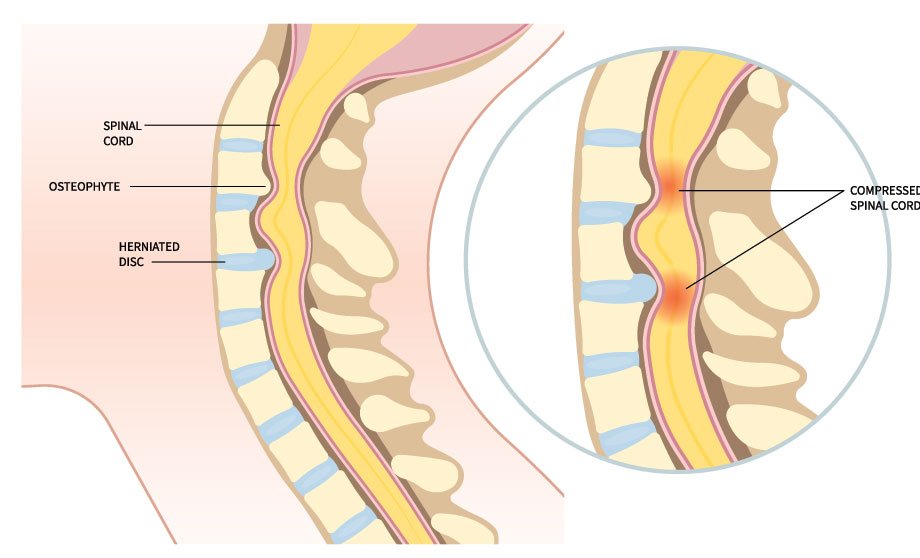
The cervical spine houses the primary neurological superhighway connecting the brain to the rest of the body. When age-related wear, herniated discs, thickened ligamentum flavum, or posterior bone spurs (osteophytes) narrow the spinal canal, mechanical pressure builds directly against the spinal cord.
[Spinal Canal Narrowing] ──► Direct Compression + Micro-Vascular Ischemia
│
▼
[Central Cord Dysfunction] ──► Impaired Neural Signals Below the Level of Injury
│
▼
[Neurological Progression] ──► Loss of Hand Dexterity, Balance Failures, & Incontinence
This chronic compression compromises micro-vascular blood supply to sensitive spinal cord tissue (ischemia), leading to progressive neurological deterioration that does not resolve on its own.
Cervical myelopathy frequently onset quietly without severe neck pain, making early identification critical:
┌──► 1. Hand Clumsiness (Difficulty buttoning shirts, typing, key turning)
├──► 2. “Off-Balance” Walking (Unsteadiness in dark, wide-stance gait)
[EARLY MYELOPATHY SIGNS] ─┼──► 3. Lhermitte’s Sign (Electric shock feeling down spine on neck flexion)
├──► 4. Loss of Fine Motor Grip (Dropping coffee mugs or utensils)
└──► 5. Sphincter Urgency (Progressive bladder/bowel control changes)
One of the earliest symptoms is a subtle loss of hand coordination. Patients often notice difficulty with fine tasks such as buttoning a shirt, tying shoelaces, writing legibly, or manipulating small objects like keys and coins.
Spinal cord compression disrupts proprioception—the brain’s ability to sense foot position in space. Patients report feeling “off-balance” or drunk while walking, frequently catching themselves needing to widen their stance or hold onto walls, especially in low-light environments.
Flexing the neck forward toward the chest can trigger a brief, electrical shock-like sensation that radiates down the back and into the arms or legs, signaling severe central cord impingement.
As intrinsic hand muscle weakness develops, patients experience decreased grip strength, frequently dropping lightweight items like coffee mugs, pens, or cell phones without realizing their grip relaxed.
In moderate-to-severe myelopathy stages, compression impairs autonomic spinal pathways, leading to sudden urinary urgency, frequency, or difficulty completely emptying the bladder.
| Diagnostic Parameter | Cervical Radiculopathy | Cervical Myelopathy (CSM) |
| Anatomical Target | Single exiting nerve root | Central spinal cord |
| Primary Symptom | Sharp, radiating pain down one arm | Hand clumsiness, gait instability, imbalance |
| Reflex Profile | Hypoactive (diminished) reflexes | Hyperactive (brisk) reflexes / Positive Hoffmann’s sign |
| Bowel / Bladder Impact | None | Possible in advanced compression |
| Natural Progression | Often responds to physical therapy / injections | Progressive step wise neurological decline |
Because spinal cord tissue has limited capacity to regenerate once permanently scarred (myelomalacia), non-surgical care like physical therapy cannot reverse structural cord compression. Clinical evaluation incorporates high-resolution 3D MRI imaging alongside specialized neurological exams (such as testing for Hoffmann’s sign and hyperreflexia).
When surgery is required to relieve cord pressure, Dr. Evan Trapana utilizes motion-conscious and minimally invasive surgical techniques tailored to the patient’s individual anatomy:
Ignoring hand clumsiness, balance issues, or subtle neck stiffness can allow spinal cord damage to progress unchecked. Through early diagnostic MRI evaluation and modern motion-preserving surgical pathways, Dr. Evan Trapana provides patients across Miami and South Florida with expert neurological decompression designed to protect spinal cord health and preserve long-term mobility.