
-
Miami, Florida
-
Mon-Fri 8 am- 6pm (EST)
Patients from all over the US come to see Dr. Trapana due to his world class expertise in Spine
Chronic neck pain that radiates down into the shoulder, arm, or hand—a condition known as cervical radiculopathy—can make simple daily movements exhausting. When an intervertebral disc in the neck herniates or breaks down due to degenerative disc disease, it compresses nearby spinal nerves or the spinal cord itself.
For decades, the standard surgical gold standard for treating severe cervical disc disease was Anterior Cervical Discectomy and Fusion (ACDF). While ACDF effectively relieves nerve compression by removing the damaged disc and fusing the adjacent neck bones together, it permanently eliminates natural motion at that segment.
At the University of Miami Health System and Jackson Memorial Hospital, orthopedic spine specialist Dr. Evan Trapana utilizes Artificial Cervical Disc Replacement (Cervical Arthroplasty) as an advanced, motion-preserving alternative. By replacing the damaged disc with a modern medical device designed to mimic natural neck biomechanics, Dr. Trapana relieves nerve pain while maintaining full neck mobility and protecting neighboring spinal levels.
To choose the right surgical treatment for your neck, it helps to understand how each option alters your spinal mechanics:
During ACDF, the surgeon removes the herniated or degenerate disc, places a bone graft or synthetic spacer in the empty space, and secures a metal plate with screws across the adjacent vertebrae. Over time, the two bones grow together into a single, solid piece of bone.
During disc replacement, Dr. Trapana removes the damaged disc material to decompress the compressed spinal nerves, just as in ACDF. However, instead of placing a rigid bone graft and plate, he inserts a high-tech artificial cervical disc composed of medical-grade metals and durable polymers.
[ACDF (Fusion)] ──> Decompresses Nerves ──> Fuses Vertebrae ──> Permanent Loss of Motion
VS.
[Disc Replacement (Cervical Arthroplasty)] ──> Decompresses Nerves ──> Inserts Prosthesis ──> Full Motion Preserved
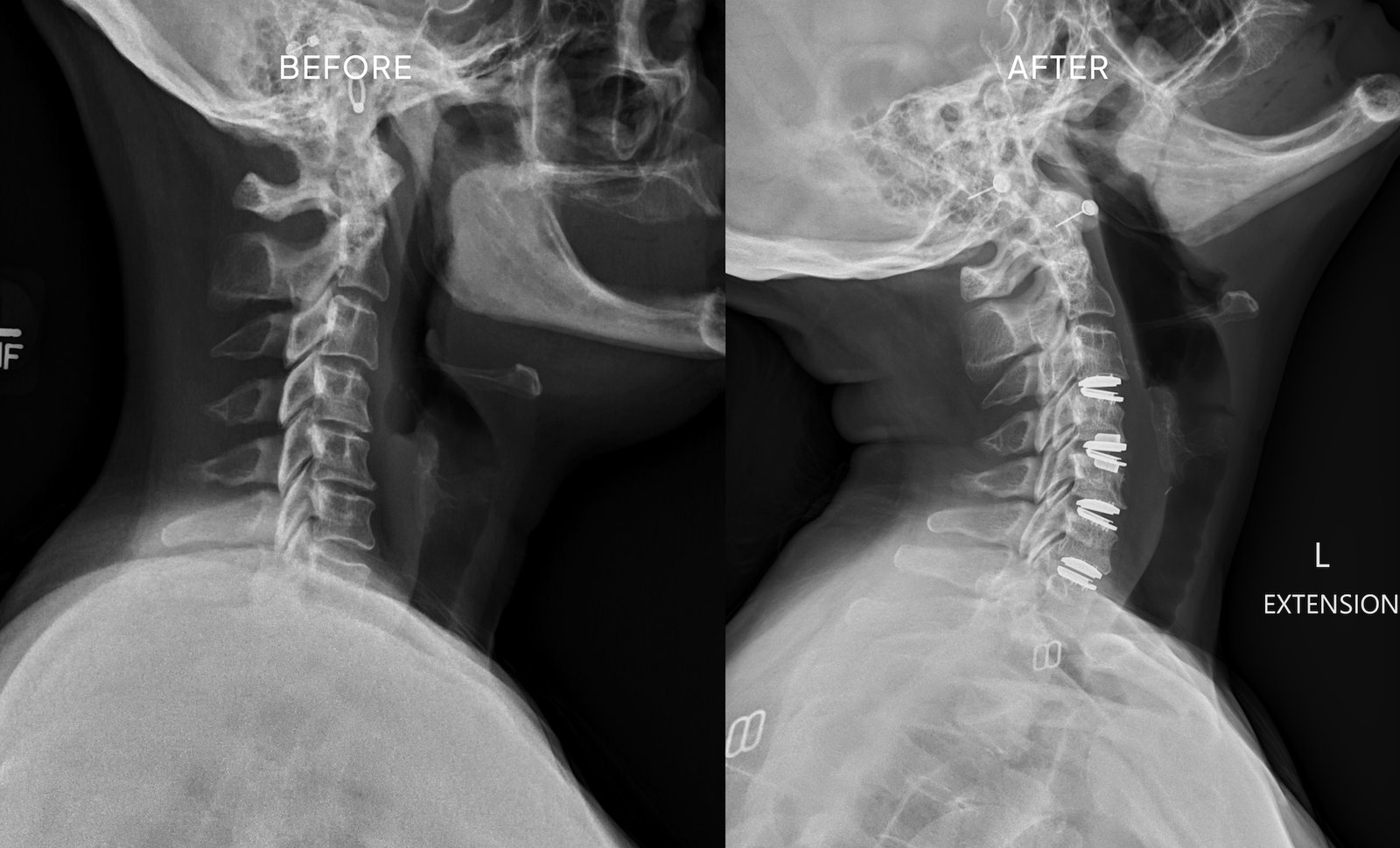
The primary long-term biological benefit of artificial disc replacement is reducing the risk of Adjacent Segment Disease (ASD).
When a segment of the neck is fused, the adjacent disc levels are forced to hyper-rotate and absorb additional mechanical strain every time you look up, down, or turn your head. Clinical studies show that within 10 years of a cervical fusion, up to 25% of patients develop symptomatic disc degeneration at neighboring levels, often requiring secondary surgeries.
By maintaining normal range of motion and preserving natural shock-absorption kinetics, artificial disc replacement prevents this hyper-mobility stress, protecting healthy neighboring discs and lowering the likelihood of future neck surgeries.
| Clinical Metric | Traditional Cervical Fusion (ACDF) | Dr. Evan Trapana’s Disc Replacement |
| Nerve Decompression | Complete relief of nerve impingement | Complete relief of nerve impingement |
| Neck Mobility | Permanent loss of motion at treated level | Natural range of motion preserved |
| Adjacent Segment Stress | Increased mechanical stress on neighboring discs | Significantly reduced stress on neighboring discs |
| Post-Op Neck Collar | Rigid collar often required for weeks | Minimal collar use (often none or soft collar) |
| Bone Fusion Risk | Risk of non-union (pseudarthrosis) | Zero risk (no bone fusion required) |
| Recovery Window | Return to full activity in 6–12 weeks | Faster return to normal activities (2–4 weeks) |
Artificial disc replacement is a highly effective procedure for eligible patients, but candidate selection is essential. Ideal candidates generally include:
Note: Patients with severe multi-level osteoarthritis, spinal instability, or osteoporosis may still be better served by traditional fusion techniques.
Relieving severe arm pain and neck stiffness does not require sacrificing your natural flexibility. Through advanced Artificial Cervical Disc Replacement, Dr. Evan Trapana provides patients across Miami and South Florida with an innovative, motion-preserving pathway toward lasting relief.