
-
Miami, Florida
-
Mon-Fri 8 am- 6pm (EST)
Patients from all over the US come to see Dr. Trapana due to his world class expertise in Spine
Chronic, burning, or shooting leg pain—clinically known as neuropathic radicular pain—is a deeply debilitating condition. When leg pain persists despite conservative management like physical therapy, medication, or epidural injections, patients often feel caught between two distinct medical pathways: surgical nerve decompression or advanced pain modulation.
Distinguishing between pain caused by ongoing mechanical nerve compression versus pain driven by maladaptive, damaged nerve signaling (neuropathy) is the single most critical factor in choosing the correct treatment. Applying the wrong therapy—such as decompressing a nerve that is no longer physically pinched or attempting neuromodulation when a large disc fragment is actively crushing a nerve root—leads to treatment failure.
At the University of Miami Health System and Jackson Memorial Hospital, orthopedic spine surgeon Dr. Evan Trapana utilizes structured diagnostic algorithms to identify the exact mechanism of intractable leg pain. By differentiating structural impingement from neuropathic signaling, Dr. Trapana offers targeted microdecompression or refers patients for Spinal Cord Stimulation (SCS) to achieve definitive relief.
To select the effective intervention, clinicians must determine whether the underlying problem is a physical obstacle or an electrical signal defect:
[Mechanical Compression] ──► Physical Pressure on Nerve Root ──► Targeted Microdecompression
VS.
[Neuropathic Processing] ──► Damaged/Hypersensitive Signal ──► Spinal Cord Stimulation (SCS)
When a herniated disc, bone spur, or narrowed exit window (foraminal stenosis) physically squeezes a spinal nerve root, it produces sharp, shooting pain down a specific nerve pathway (dermatome). The primary goal is structural: remove the physical pressure to restore normal blood flow and electrical conduction down the nerve.
In cases of severe, long-standing nerve injury or post-surgical scar formation (epidural fibrosis), the physical compression may be resolved, but the nerve remains permanently hypersensitive. The damaged nerve continuously fires abnormal pain signals to the brain. In this scenario, structural surgery cannot fix the issue because there is no remaining physical structure to decompress. The primary goal becomes altering signal transmission.
When high-resolution MRI scans confirm that a physical barrier is pressing on a nerve root, Targeted Microdecompression (such as endoscopic discectomy or micro-laminotomy) is the primary line of surgical defense.
[Micro-Incision (< 1 cm)] ──► 10x Magnified HD Endoscopic Visualization
│
▼
[Selective Tissue Removal]──► Direct extraction of herniated disc fragment or bone spur
│
▼
[Nerve Relief] ──► Physical nerve root un-pinched & blood flow restored
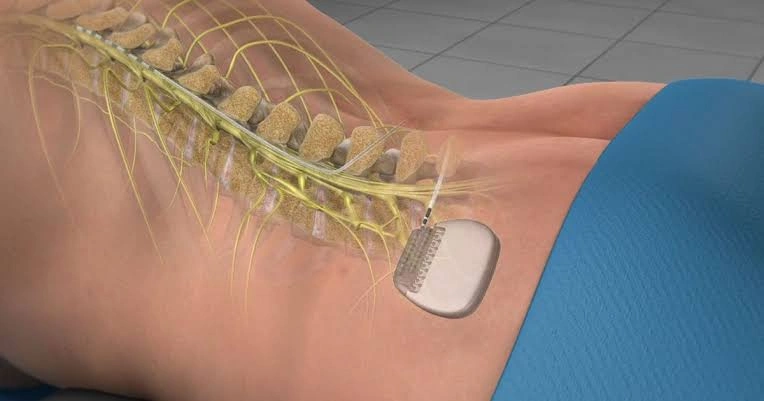
When imaging shows no remaining physical nerve compression, but burning, intractable leg pain persists, Spinal Cord Stimulation (SCS) offers an effective non-structural solution.
[Epidural Lead Placement] ──► Delivers mild electrical micro-pulses to spinal cord
│
▼
[Gate Control Mechanism] ──► Overrides & intercepts pain signals before reaching brain
│
▼
[Sensation Shift] ──► Replaces burning leg pain with a soothing sensation or zero pain
| Clinical Parameter | Targeted Microdecompression | Spinal Cord Stimulation (SCS) |
| Primary Target | Physical structure (disc, bone, ligament) | Electrical pain signals in dorsal columns |
| Diagnostic Marker | MRI shows direct, active nerve compression | MRI shows no active compression or scar tissue |
| Surgical Objective | Removes physical tissue pinching the nerve | Alters neuro-electrical signal transmission |
| Reversibility | Permanent structural alteration | Fully reversible; device can be removed |
| Trial Period | No trial phase available | Mandatory 5-to-7-day temporary trial |
| Best For | Acute herniation, focal stenosis, weakness | Chronic burning pain, dense scarring, neuropathy |
To prevent inappropriate treatment selection, Dr. Trapana utilizes a rigorous diagnostic evaluation:
Living with intractable leg pain requires an accurate diagnosis of whether your pain stems from physical nerve compression or damaged electrical signaling. Through comprehensive diagnostic evaluations and targeted interventions, Dr. Evan Trapana helps patients across Miami and South Florida find the right pathway toward lasting pain relief and restored daily function.