
-
Miami, Florida
-
Mon-Fri 8 am- 6pm (EST)
Patients from all over the US come to see Dr. Trapana due to his world class expertise in Spine
A herniated disc in the lumbar or cervical spine can immediately halt an active lifestyle. When an intervertebral disc tears or bulges, compressing adjacent spinal nerve roots, the resulting radiculopathy (sciatica or shooting arm pain) can make simple movements agonizing. For years, patients who failed conservative treatments like physical therapy or epidural injections were told that major spinal surgery—often involving bone removal, muscle stripping, and titanium hardware fusion—was their primary option.
Modern spinal care has shifted toward motion preservation and targeted decompression. At the University of Miami Health System and Jackson Memorial Hospital, orthopedic spine surgeon Dr. Evan Trapana utilizes ultra-minimally invasive endoscopic spine surgery. By accessing the herniated disc material through a tiny incision using HD micro-cameras, Dr. Trapana relieves nerve compression while preserving the natural movement and structural integrity of your spine.
To evaluate your surgical options, it helps to understand how each procedure alters spinal anatomy:
Open spinal fusion is designed to treat structural instability alongside nerve compression. The surgeon creates a long midline back incision, strips stabilizing spinal muscles off the bone, removes the offending disc entirely, and places bone grafts alongside titanium screws and rods to permanently fuse two or more vertebrae together. While necessary for severe deformities or major instability, fusion eliminates natural spinal motion at that segment, increasing stress on adjacent discs over time.
Endoscopic spine surgery is an ultra-targeted decompression technique. Instead of cutting muscle or fusing bone, Dr. Trapana inserts a slender, high-definition endoscope—about the width of a pencil—through a micro-incision (typically less than 1 cm). Guided by live HD video monitors, microscopic instruments gently navigate through natural anatomical windows to remove only the herniated disc fragment pressing on the nerve, leaving healthy disc tissue and surrounding muscles intact.
[Open Fusion] ──> Strips muscles ──> Eliminates motion ──> Fuses vertebrae with hardware
VS.
[Endoscopic Relief] ──> Spares muscles ──> Preserves motion ──> Removes ONLY compressing fragment
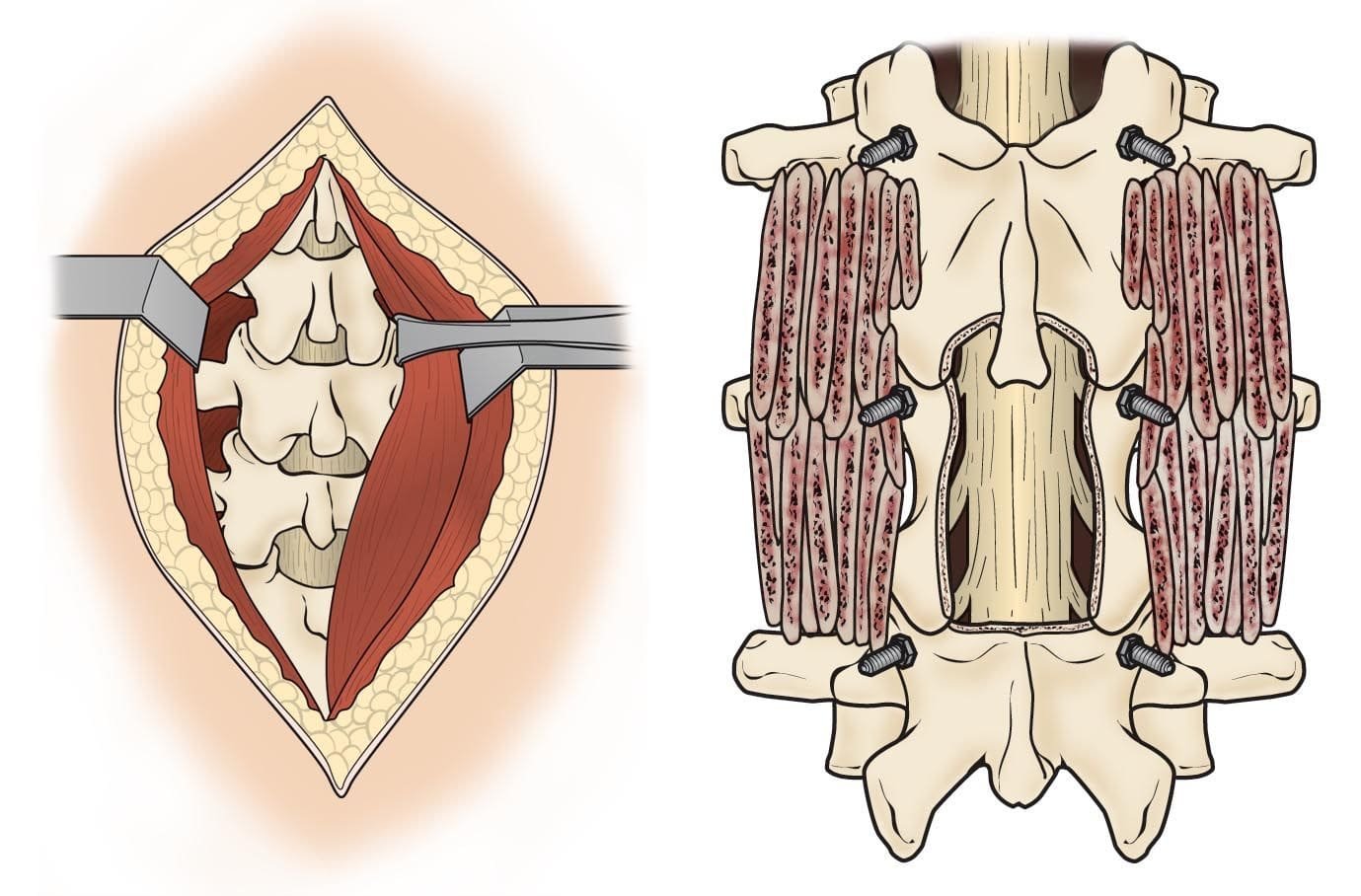
| Surgical Metric | Traditional Open Spinal Fusion | Dr. Evan Trapana’s Ultra-Minimally Invasive Endoscopy |
| Incision Size | 3 to 6+ inches down the back | Micro-incision (< 1 cm) |
| Muscle Trauma | Significant tearing and retractor stretching | Muscle-sparing; dilation around fibers |
| Spinal Mobility | Permanent loss of motion at fused segment | 100% motion preservation |
| Anesthesia & Setting | General anesthesia; multi-day hospital stay | Same-day outpatient procedure; light sedation |
| Post-Op Pain & Meds | High pain profile; prolonged opioid reliance | Substantially reduced pain; rapid off-ramp |
| Recovery Window | 3 to 6+ months for bone fusion | Return to light activities in 1 to 2 weeks |
Fusing a spinal segment restricts natural movement, transferring rotational forces to the discs directly above and below (Adjacent Segment Disease). Endoscopic discectomy preserves normal spinal kinematics, reducing the risk of accelerated wear on neighboring spinal levels.
Traditional back surgeries require significant bone removal (laminectomy), exposing the spinal canal and predisposing patients to dense internal scar tissue (epidural fibrosis) that can cause persistent nerve pain. Endoscopic techniques access the herniation through natural anatomical corridors (transforaminal or interlaminar), minimizing internal scarring around the delicate nerve root.
Because endoscopic surgery avoids major soft-tissue disruption and blood loss, the overwhelming majority of patients undergo the procedure in an outpatient ambulatory setting. Patients frequently walk out of the facility within hours of surgery, experiencing immediate relief from radiating nerve pain.
While open fusion remains vital for severe spinal deformities, high-grade spondylolisthesis, or complex trauma, endoscopic surgery is an effective solution for targeted nerve compression conditions:
Suffering from a herniated disc or severe sciatica does not mean you have to accept major spinal fusion or prolonged recovery times. Through ultra-minimally invasive endoscopic spine techniques, Dr. Evan Trapana offers patients across South Florida a precise, motion-preserving path toward lasting relief.