
-
Miami, Florida
-
Mon-Fri 8 am- 6pm (EST)
Patients from all over the US come to see Dr. Trapana due to his world class expertise in Spine
Spinal stenosis—the narrowing of the central spinal canal or neural foramina—is one of the leading causes of back pain, leg weakness, and impaired mobility in adults. As degenerative changes cause spinal ligaments to thicken, bone spurs (osteophytes) to form, and intervertebral discs to collapse, encroaching tissue compresses delicate spinal nerves. For many, this results in neurogenic claudication: severe cramping, heaviness, or burning pain in the legs that worsens with walking or standing upright.
Historically, surgical intervention for complex or multi-level spinal stenosis presented a stark trade-off. Traditional open laminectomy combined with rigid fusion required wide bone resections and extensive muscle dissection, permanently locking the spine in place and increasing stress on adjacent levels.
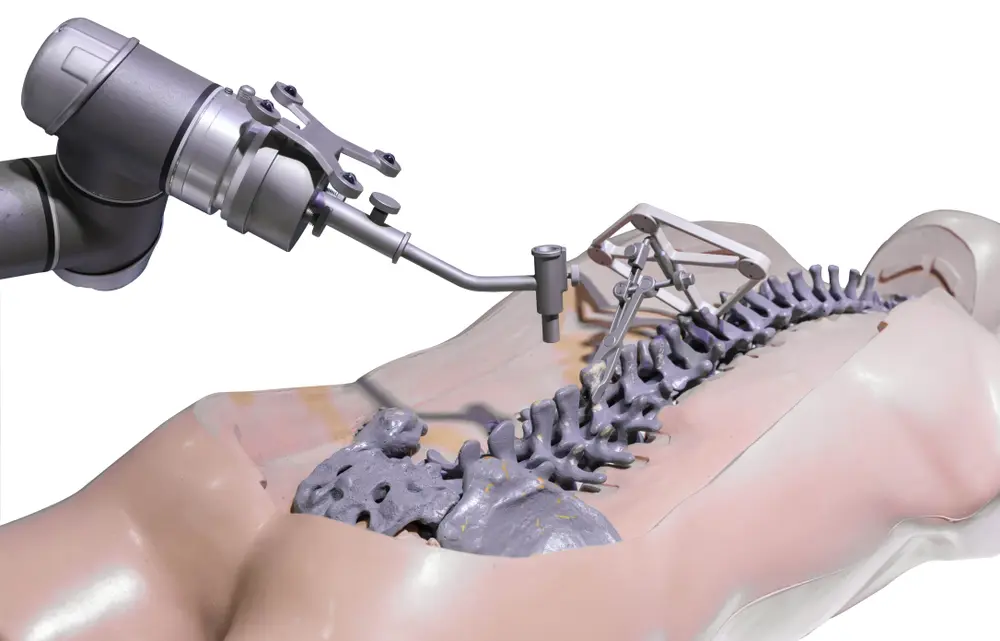
At the University of Miami Health System and Jackson Memorial Hospital, orthopedic spine surgeon Dr. Evan Trapana utilizes Robotic-Assisted Motion Preservation Surgery. By integrating real-time 3D navigation and sub-millimeter robotic guidance with advanced, motion-sparing decompression techniques, Dr. Trapana relieves severe nerve compression with unparalleled surgical accuracy while protecting the structural integrity and mobility of the spine.
Treating complex or multi-level spinal stenosis requires a careful balance between thorough decompression and structural stability:
Robotic-assisted technology resolves this challenge by providing exact pre-operative 3D mapping and real-time intraoperative guidance, allowing for targeted nerve decompression that spares critical stabilizing structures.
Robotic-assisted spine surgery does not replace the surgeon’s skill; rather, it serves as a high-precision GPS navigation platform that executes Dr. Trapana’s custom-designed surgical plan with sub-millimeter accuracy.
[3D Intraoperative Mapping] ──► Real-time anatomical registration & trajectory planning
│
▼
[Robotic Guidance Arm] ──► Sub-millimeter instrument stabilization & bone sculpting
│
▼
[Targeted Decompression] ──► Maximum nerve relief with zero unnecessary bone removal
Before making an incision, high-resolution CT scans create a detailed 3D digital model of the patient’s precise spinal anatomy. Dr. Trapana plans the exact angles and trajectories required to decompress cramped nerve canals without injuring nearby facet joints or stabilizing ligaments.
During surgery, a robotic guidance arm aligns precisely along the planned trajectory. The robotic platform holds micro-instruments rigidly in place, preventing hand tremors or slippage near delicate neural structures.
Guided by 3D optical tracking, Dr. Trapana removes only the specific bone spurs and thickened ligamentum flavum causing nerve impingement. By preserving the facet joints and interspinous ligaments, the natural mechanics and motion of the spine remain intact, eliminating the need for rigid fusion hardware in eligible candidate cases.
| Clinical Feature | Traditional Open Laminectomy & Fusion | Dr. Evan Trapana’s Robotic Motion Preservation |
| Surgical Precision | Visual estimation based on manual anatomical landmarks | Sub-millimeter 3D robotic guidance |
| Structural Impact | Extensive bone removal and wide muscle stripping | Targeted bone sculpting; vital joints & ligaments spared |
| Spinal Mobility | Permanent loss of motion at fused levels | Natural spinal movement preserved |
| Radiation Exposure | Repeated intraoperative X-ray (fluoroscopy) shots | Reduced radiation exposure via single 3D scan registration |
| Adjacent Segment Stress | High risk of accelerated wear at neighboring levels | Significantly lower risk due to maintained mobility |
| Recovery Window | Prolonged hospital stay and extended rehab | Faster recovery, reduced pain, and earlier mobility |
Severe leg pain, numbness, and standing difficulty caused by complex spinal stenosis do not mean you have to settle for rigid spinal fusion or a permanent loss of back flexibility. Through robotic-assisted motion preservation surgery, Dr. Evan Trapana offers patients across Miami and South Florida a technologically advanced, highly precise path toward lasting nerve relief and natural mobility.